
June Bulletin MBA Placement-Ready : Read, Prepare, and Win Your Dream Job with Confidence.
An MBA/PGDM degree opens the door, but AI-enabled sector capability wins the placement.
The websites position Dr. Bhargava Teja Balijepalli’s work as continuing research, scholarship, archive and public-service legacy, with Dasu’s Balijepalli preserving writings, research, publications and memories, and the Trust carrying forward research, scholarship, archives, cultural learning and public service.
For management graduates, faculty and business schools
Core idea
Management education must move from qualification delivery to placement capability creation. Every MBA/PGDM student should be trained from the first day as a future sector-ready professional, not as a generic graduate.
Why this designed framework matters for MBA’s
Today’s recruiters do not hire only degrees. They hire visible capability: tools, certifications, projects, dashboards, internships, role clarity and interview confidence. Therefore, MBA/PGDM programmes must integrate AI tools, analytics platforms, sector certifications and applied learning into the curriculum.
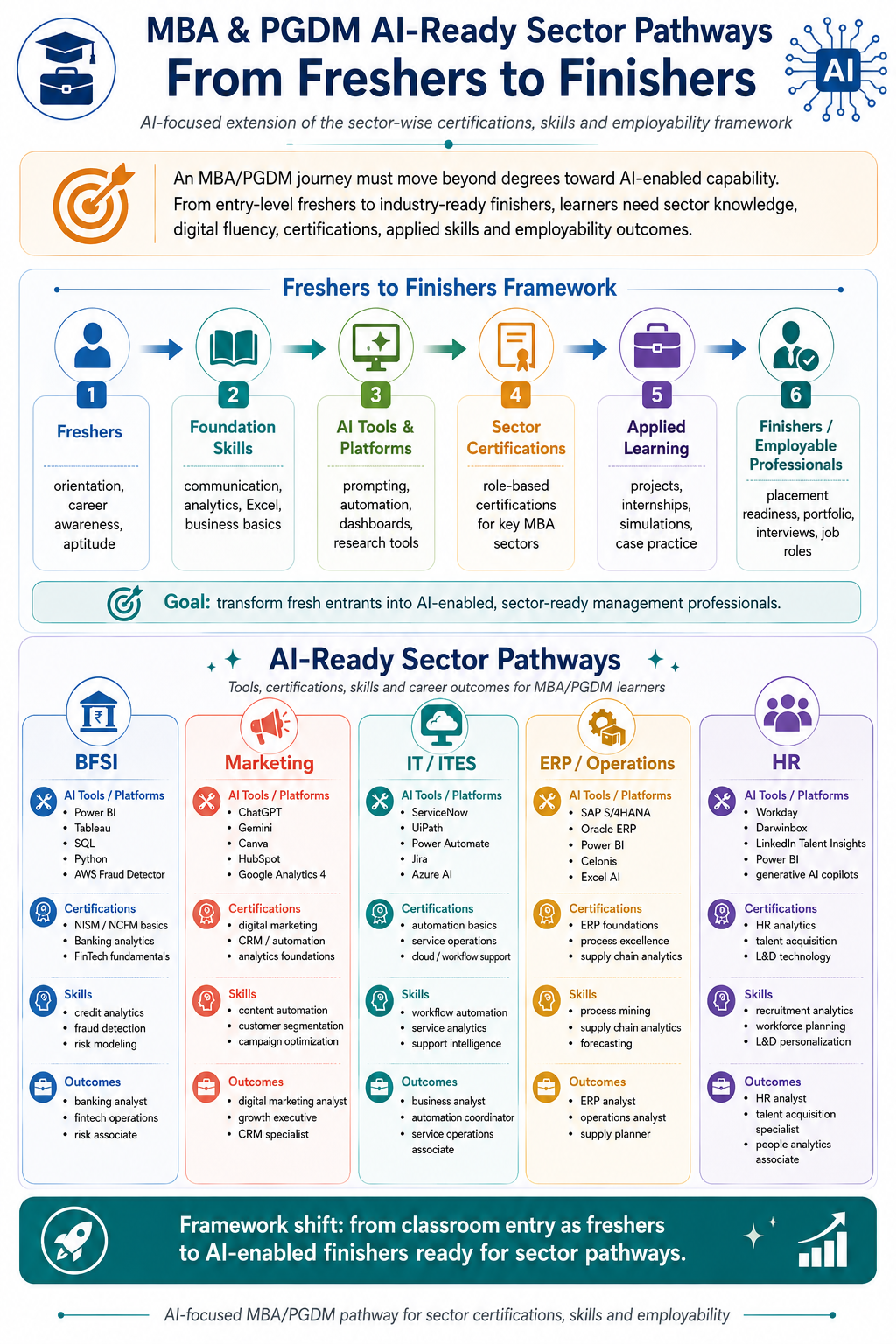
I.Freshers-to-Finishers Royal Pathway
Stage 1: Freshers
Students enter with different backgrounds. They need orientation, career awareness, aptitude mapping and sector exposure.
Stage 2: Foundation Skills
They must build communication, Excel, business basics, analytics, presentation, writing and problem-solving.
Stage 3: AI Tools & Platforms
Students must learn prompting, automation, dashboards, research tools, CRM platforms, HR tech, ERP systems and analytics tools.
Stage 4: Sector Certifications
Each student must select a placement track such as BFSI, Marketing, IT/ITES, ERP/Operations or HR and complete role-based certifications.
Stage 5: Applied Learning
Projects, internships, case simulations, live dashboards, market research, process mapping and HR analytics labs should become compulsory.
Stage 6: Finishers / Employable Professionals
A finisher must leave the programme with a portfolio, role clarity, interview readiness, certification proof and sector-specific employability evidence.
II. Sector-wise AI employability focus
- BFSI: Power BI, Tableau, SQL, Python and fraud detection tools should lead to roles such as banking analyst, fintech operations associate and risk analyst.
- Marketing: ChatGPT, Gemini, Canva, HubSpot and Google Analytics 4 should support roles in digital marketing, growth, CRM and customer analytics.
- IT/ITES: ServiceNow, UiPath, Power Automate, Jira and Azure AI should prepare students for business analyst, automation coordinator and service operations roles.
- ERP/Operations: SAP S/4HANA, Oracle ERP, Power BI, Celonis and Excel AI should prepare students for ERP analyst, operations analyst and supply planner roles.
- HR: Workday, Darwinbox, LinkedIn Talent Insights, Power BI and AI copilots should prepare students for HR analyst, talent acquisition and people analytics roles.
III.Placement strategy from starting day
Day One: Career orientation, aptitude diagnosis and AI literacy.
Month One: Resume draft, LinkedIn profile and sector awareness.
Semester I: Excel, communication, business analytics and presentation skills.
Semester II: Sector tools, certifications and mini projects.
Semester III: Internship, live projects, dashboards and recruiter mapping.
Semester IV: Mock interviews, role-based portfolios and placement conversion.
- Faculty action agenda
Faculty should not treat AI tools as optional add-ons. Each subject can include one AI-enabled output: a dashboard, chatbot prompt, campaign audit, HR analytics report, risk model, ERP process map, or consulting-style deck.
- Institution action agenda
Business schools should create a Placement Readiness Lab with five verticals:
AI Tool Lab
Sector Certification Lab
Communication and Interview Lab
Live Project and Portfolio Lab
Recruiter Mapping and Placement Lab
Final takeaway
Semester-wise placement milestones. For example: Semester I should focus on aptitude, Excel, communication and AI literacy; Semester II on certifications and dashboards; Semester III on internships, live projects and portfolio; Semester IV on interview readiness, role mapping and placement conversion. This would make it more actionable for faculty and placement cells.
Remember The future MBA is not only a graduate. The future MBA is an AI-enabled, sector-certified, project-tested and placement-ready professional.
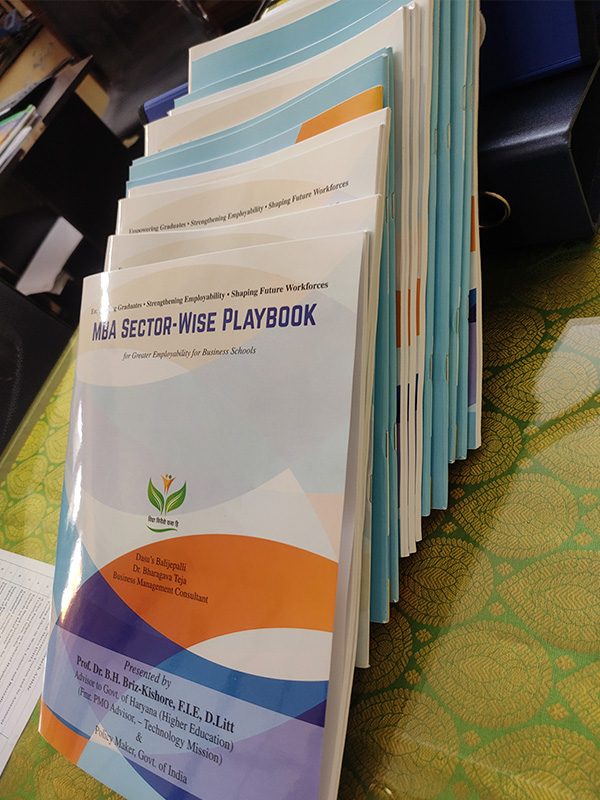
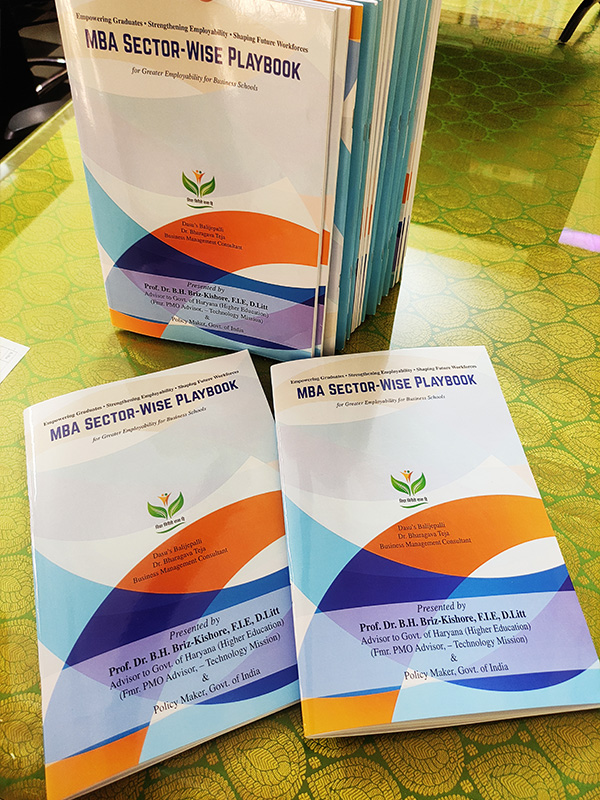
MBA Sector-Wise PlayBook
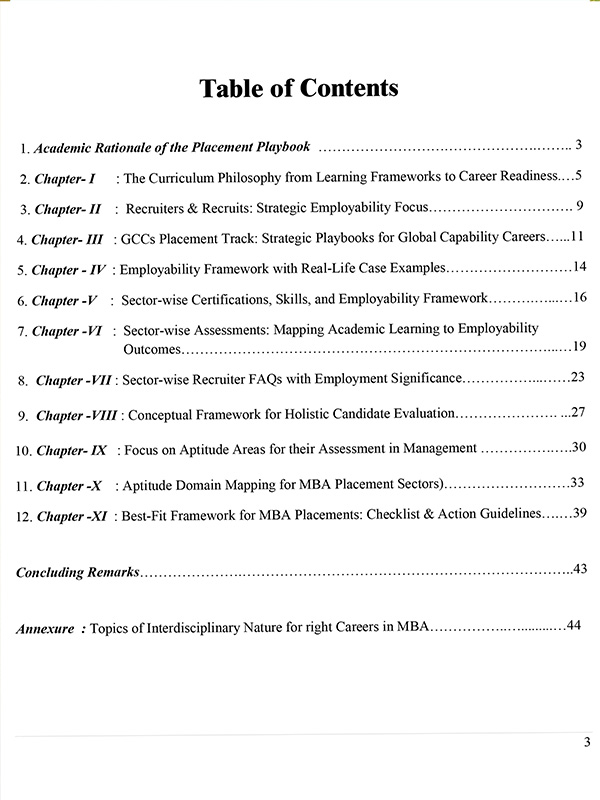
In academic and strategic contexts, a playbook is understood as a structured guide that translates
abstract goals into practical, step-by-step strategies. Borrowed from sports and widely adopted in
business management, a playbook is not only descriptive (what exists) but also prescriptive (what to
do, how to do it, and when to do it). This Placement Playbook is conceived and structured by
Dr. B. Bhargava Teja as both a curriculum aligned academic document and a market-facing strategic
framework and executed by Prof. Dr. B. H. Briz-Kishore, Eminent Educationist & Policy Maker,
Government of India for student employability and recruiter engagement.

If you need any contextual information related to the playbook, please email us at dasusdrbhargavateja.trust@gmail.com
About Author
Dr. Bhargava Teja Dasu’s Balijepalli was the gifted son of Prof. Dr. B.H. Briz-Kishore, an eminent educationist, and Dr. Hymavathi, a noted Diabetologist. His untimely passing left a profound void, yet his brilliance continues to guide and inspire.
A scholar of exceptional promise, Teja earned his PhD in Management from Dravidian University, Andhra Pradesh. His contributions spanned management consulting, academic research, and multimedia design. His work on event management strategies is widely cited, and his book on Multimedia Applications reflects his command over graphic media and animation. As a reviewer for leading journals, he was respected for his analytical depth and interdisciplinary insight.
Professionally, Teja served as a consultant at Shris Infotech Services and advised institutions including B.R. Ambedkar Open University and ICFAI University through its chairman IDB. His academic journey—BCA, MBA, and PhD—exemplified dedication, curiosity, and global perspective rooted in strong Indian values.

The publication of this commemorative series honours not only his achievements but the spirit with which he lived—humble, creative, and committed to meaningful work. As a father, I offer this Playbook in loving memory of a son whose brilliance lay not only in his accomplishments but in the sincerity with which he pursued knowledge, truth, and service. His light continues to shape our purpose and inspire all who knew him.
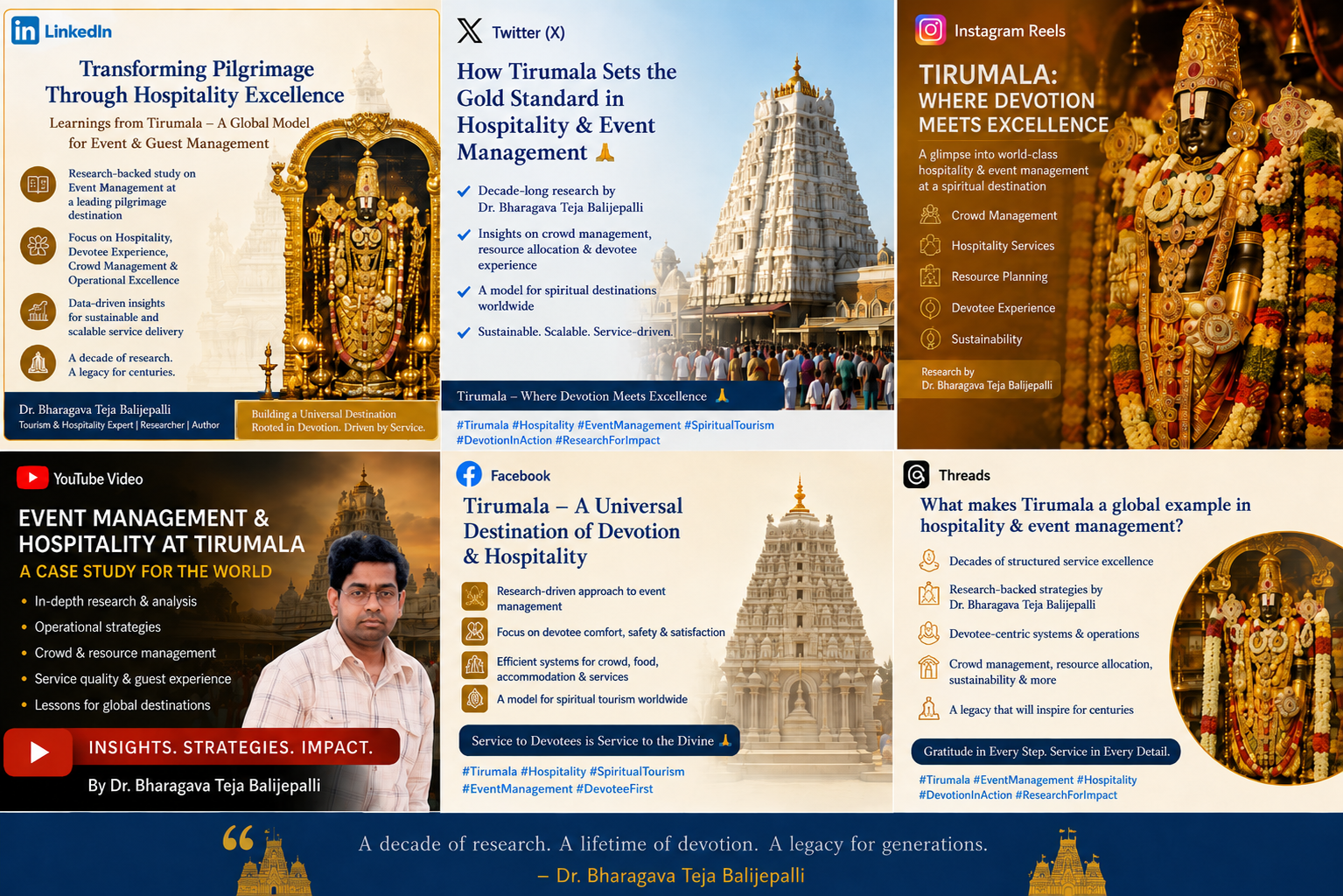
Case Study in Event Management & Hospitality At Tirumala
Hospitality at spiritual destinations is not merely a service function; it is an institutional responsibility. A study on hospitality services at Tirumala highlights that visitors are not just tourists, but pilgrims, families, elders, children, and devotees with deep emotional and spiritual expectations. Therefore, hospitality must combine operational efficiency with human sensitivity.
The report focuses on key areas such as accommodation, reservations, sanitation, food services, digital information, budgeting, outsourcing, safety, cleanliness, and interdepartmental coordination. Its central message is that Atithi Devo Bhava must move from slogan to system, supported by trained staff, transparent processes, digital access, feedback mechanisms, and compassionate service.